OCT 26, 2026 12:00 PM
:
What Is Stop Hunting In Trading & How Does It Work?
What Is Stop Hunting In Trading & How Does It Work?
Have you ever placed a stop-loss order, watched the market move against you just long enough to trigger it, and then seen the price head in your original direction? You might have wondered whether you experienced stop hunting.
Stop hunting is a term traders use to describe price movements that trigger clusters of stop-loss orders, sometimes followed by a sharp reversal. It is a familiar topic in forex trading, where prices can move quickly around significant support and resistance levels.
Understanding stop hunting can help you interpret price movements and make more informed decisions about risk management. However, it is important to distinguish between normal market behavior and genuine manipulation.
Let's look at what stop hunting means, how it works, and what you can do to manage your trades more effectively.
What is stop hunting?
Stop hunting describes a situation where the market moves towards a price level at which many traders are likely to have placed stop-loss orders.
When these orders are triggered, they can generate additional buying or selling activity, potentially accelerating the price movement.
A stop-loss order is designed to close a trade when the market reaches a specified price. For example, if you buy EUR/USD at 1.1000 and set a stop-loss at 1.0950, your position is intended to close if the price falls to that level.
Traders commonly place stop-losses around obvious chart levels, including recent highs and lows, support and resistance zones, and round numbers. These areas can attract multiple orders because traders often use similar technical analysis.
When the market reaches one of these levels, triggered orders may contribute to a sharp move. If the price quickly reverses, traders may describe the event as stop hunting or a liquidity sweep.
However, a price movement that triggers stop-losses does not automatically prove deliberate manipulation. It may simply reflect changing supply and demand, economic news, or ordinary market volatility.
How does stop hunting work in forex trading?
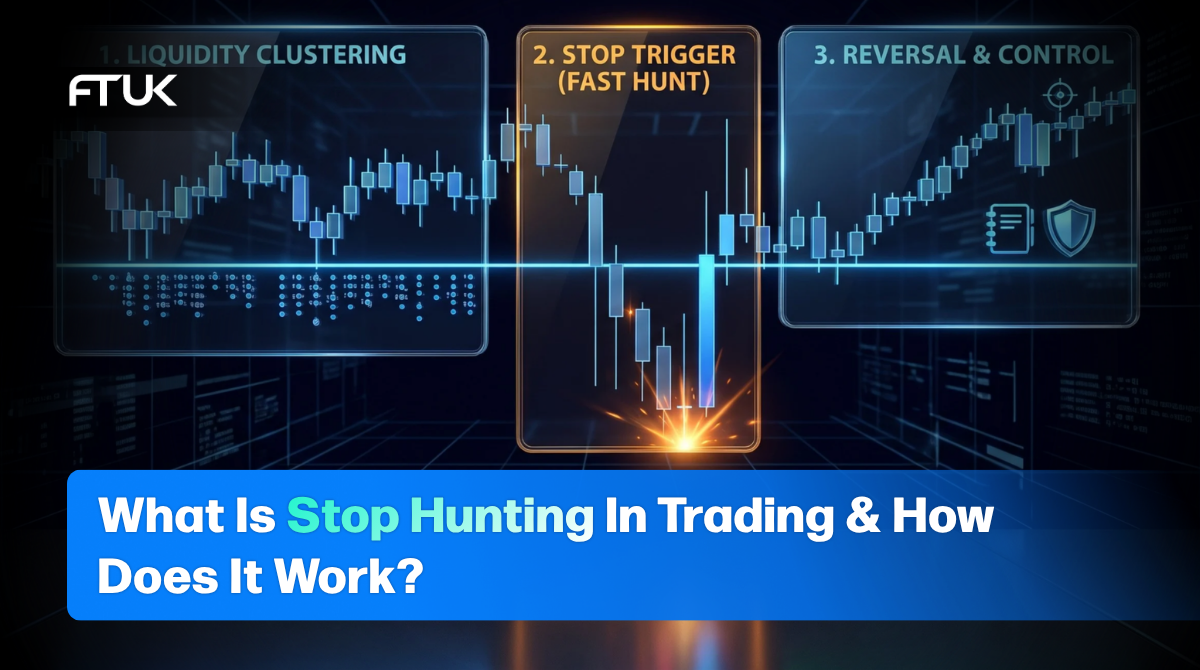
Understanding stop hunting becomes easier when you break the process into three stages.
1. Traders place stop-loss orders around key levels
Imagine GBP/USD is trading around 1.2750, with a recent swing low at 1.2700. Several traders have bought the currency pair, expecting it to rise. To manage their risk, they place stop-losses just below the recent low, perhaps at 1.2690.
Other traders are watching the same level. Consequently, a concentration of stop orders may develop below 1.2700. Not every trader will choose the same price, of course. However, obvious support and resistance levels can attract similar trading decisions.
2. The price moves towards those orders
The market begins to fall, breaks below 1.2700 and reaches 1.2690, triggering some of the stop-losses on long positions.
These stops generally generate sell orders once triggered. Depending on market conditions and available liquidity, the additional selling can contribute to further downward movement.
This can be particularly noticeable when the market is already moving strongly or there are fewer orders available at nearby prices.
3. The market reverses or continues moving
After the stop-losses are triggered, GBP/USD might continue falling, consolidate or reverse. In this example, the price briefly drops to 1.2685 before recovering above 1.2700.
Traders who were stopped out may feel that the market moved against them just before heading in their original direction. This is the kind of movement often described as a stop hunt.
However, the reversal does not reveal the precise reason behind the price movement. Buyers may have entered the market, selling pressure may have eased, or broader market conditions may have changed.
The important takeaway is that stop-loss clusters can influence price behaviour, but not every move through an obvious level is evidence of a deliberate attempt to trigger stops.
Why are stop-loss orders important to liquidity?
Liquidity describes how easily an asset can be bought or sold without significantly affecting its price.
In forex markets, liquidity varies depending on the currency pair, time of day and prevailing trading conditions. Stop-loss orders matter because they can turn into market orders once triggered, adding to the flow of buying or selling.
Certain areas may attract particular attention from traders:
- Support and resistance: Traders often place stops just beyond levels they expect to hold.
- Recent highs and lows: These provide visible reference points for technical traders.
- Round numbers: Prices such as 1.2500 or 1.3000 can attract attention.
- Economic announcements: Interest rate decisions, inflation figures and employment reports can cause rapid price changes.
- Periods of lower liquidity: Price movements may become more pronounced when fewer orders are available nearby.
Understanding these factors can help you make sense of sudden price movements without assuming that someone is deliberately targeting your position.
Is stop hunting market manipulation?
The term stop hunting is sometimes used to suggest that a large financial institution deliberately moves the market to trigger retail traders' stop-losses. Although market manipulation can occur, an apparent stop hunt does not prove that manipulation has taken place.
Large banks, liquidity providers and investment funds may execute substantial orders. They may pay attention to areas where liquidity is likely to be available, including prices around obvious highs and lows.
However, the forex market is decentralised, with trading activity spread across banks, brokers, electronic platforms and other venues. There is no single central order book showing every stop-loss order across the entire market.
As a retail trader, you generally cannot know exactly where all stop orders are located or who caused a particular price movement simply by looking at a chart.
It is therefore more useful to understand stop hunting as a description of a possible market pattern rather than proof that a broker or institution has targeted your individual trade.
How can you protect your trades from stop hunting?
You cannot prevent the market from reaching your stop-loss, but you can make more informed decisions about where you place it and how you manage risk.
1. Avoid placing stops purely at obvious levels
Placing a stop-loss just beyond a widely watched high or low may leave your trade vulnerable to ordinary price fluctuations.
That does not mean you should automatically place stops further away. A wider stop increases the potential loss per unit of position size, so you may need to reduce your position size accordingly.
Instead, consider the price level that would genuinely invalidate your trading idea. Your stop should reflect your strategy and the market structure, rather than an arbitrary distance from your entry.
2. Use sensible position sizing
Decide how much you are prepared to risk before entering a trade. For example, if you are willing to risk £50 and your stop-loss needs to be 50 pips away rather than 25 pips away, you may need to reduce your position size to keep the potential loss within your chosen limit.
This helps prevent a wider stop from automatically exposing you to a larger loss. Remember that leveraged forex trading magnifies both gains and losses. In volatile conditions, slippage can also mean your trade closes at a less favourable price than expected.
3. Be cautious around major economic announcements
Economic releases can cause rapid price movements and wider spreads. A stop-loss may be triggered by a brief spike, while execution may occur at a worse price than anticipated.
Before trading around central bank announcements, inflation reports or employment figures, consider whether your strategy is suited to these conditions.
If you are still learning, observing these events without opening a position can be a useful way to understand how volatility affects the market.
4. Wait for confirmation
When the price moves above resistance or below support, it can be tempting to enter immediately.
However, some breakouts fail. Waiting for a candle close, a retest or another signal from your established strategy may help you avoid reacting to a temporary price spike.
Confirmation does not guarantee success, and waiting can mean missing some profitable opportunities. The aim is to follow a consistent approach rather than trade out of fear of missing out.
5. Keep a trading journal
Recording your trades can help you identify whether you repeatedly place stops too close to normal market fluctuations or react impulsively after a loss.
Record your entry price, stop-loss level, position size, reasons for entering and what happened afterwards. Over time, you may identify patterns in your decision-making and find areas to improve.
You can test potential changes using historical charts or a demo account before risking real money.
Understanding stop hunting as a trader
Stop hunting can sound intimidating, particularly when you are new to forex trading or aspiring to a funded trading account with a prop firm. It may seem as though the market is constantly trying to catch individual traders out.
In reality, many movements described as stop hunting can be understood through ordinary market mechanics, including clusters of orders, changing liquidity and reactions around important price levels.
Recognising these patterns can help you make more considered trading decisions, but it is equally important not to interpret every price spike as deliberate manipulation.
Focus on understanding market structure, placing stop-losses where your trading idea is invalidated, sizing positions sensibly and following a consistent risk-management plan.
These habits are more useful in the long run than trying to predict exactly where the next stop hunt might occur.
With practice, you can become more confident in interpreting price movements and making decisions based on your strategy rather than reacting emotionally to short-term market noise.
Ready to Master Your Trading Journey?
Empowering traders with clear strategies and proven execution to thrive in prop trading.