
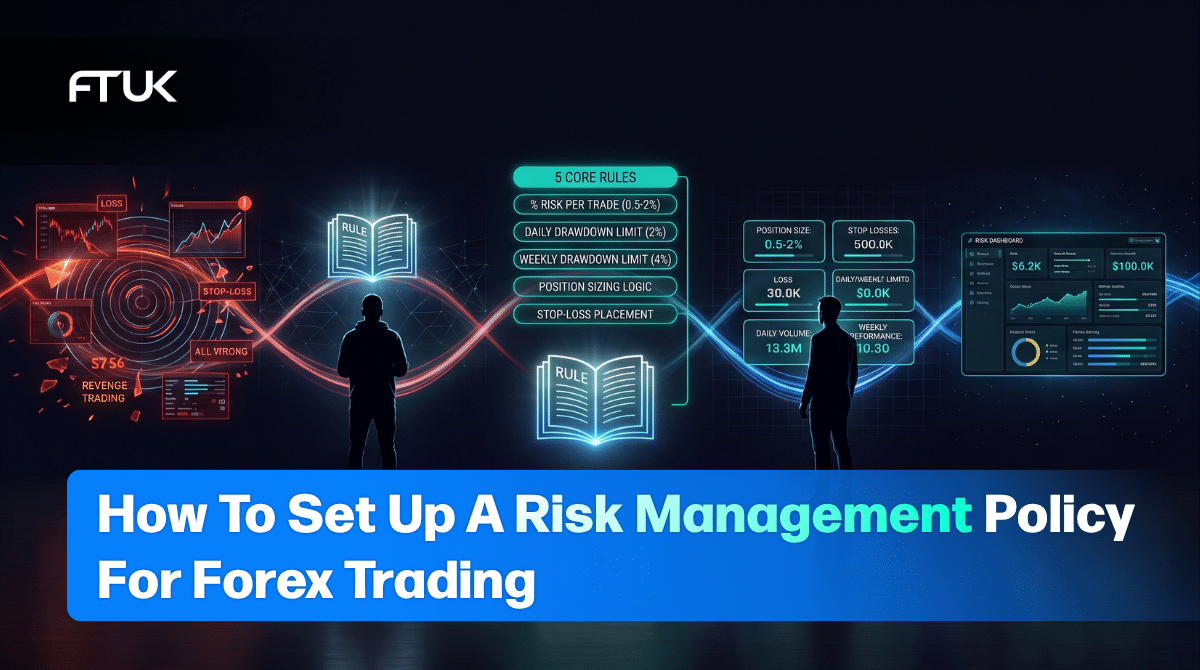
How To Set Up A Risk Management Policy For Forex Trading
If you ask experienced forex traders what separates those who survive from those who disappear after a few months, very few will say it’s finding the perfect strategy. Instead, they’ll usually attribute stickability to good risk management.
The reality is that profitable trading isn’t about avoiding losses altogether. Every trader experiences losing trades, losing days and sometimes even losing weeks. The difference is that successful traders plan for those losses before they happen.
Whether you’re trading your own capital or working towards a funded account through a pay after you pass prop firm challenge, having a written risk management policy can make your decision-making more consistent and help remove emotion from the process.
This guide explains how beginners and intermediate traders can create a practical risk management policy that supports long-term development rather than chasing quick profits. What is a forex risk management policy?
Think of your risk management policy as the rulebook for your trading business .
Instead of making decisions based on ‘gut feeling’ or what happened in your last trade, you have predefined rules covering
How much you’ll risk on each trade
Maximum daily and weekly losses
Position sizing
Stop-loss placement
Maximum leverage
Trading hours
Acceptable market conditions
When to stop trading
Professional traders rarely leave these decisions until they’re already in a position. The rules are established before the trading day begins. Why every forex trader needs written rules
One of the biggest mistakes beginners make is believing they’ll ‘just know’ when to exit a losing trade. Unfortunately trading psychology doesn’t usually work that way. Once real money is involved, emotions can quickly take over.
Without written rules, it’s easy to
Move stop losses further away
Increase position sizes after losses
Revenge trade
Hold onto losing positions hoping they’ll recover
Take unnecessary trades out of boredom
A written policy removes much of this decision-making.
Instead of asking: “What should I do now?” You simply follow the plan you created while thinking clearly. Step 1: Decide your maximum risk per trade
This is the foundation of almost every successful risk management plan Many traders choose to risk somewhere between 0.5 per cent and 2 per cent of their account on any single trade.
Beginners often stay towards the lower end until they gain more experience. The exact percentage matters less than applying it consistently.
For example
£10,000 account
0.5 per cent risk = £50
1 per cent risk = £100
2 per cent risk = £200
Notice that these figures remain the same regardless of how confident you feel. Confidence doesn’t guarantee the outcome of a trade: a consistent approach is always the best way to manage risk. Step 2: Calculate position size properly
One of the biggest misconceptions among new traders is choosing a lot size first. Professional traders work backwards.
The process should look like this
– Find the trade setup
– Identify the logical stop-loss location
– Measure the stop distance
– Calculate the position size that matches your chosen risk
This means every trade risks roughly the same percentage of your account, even if the stop-loss distance changes. Without position sizing, one trade might risk five times more than another without you even realising. Step 3: Always define your exit before entering
Before placing any trade, you should already know
Entry price
Stop-loss
Profit target
Risk-to-reward ratio
If you don’t know where you’ll exit if you’re wrong, you shouldn’t enter the trade. Many experienced traders would rather miss an opportunity than enter without a defined risk. Step 4: Set a maximum daily loss
Even good traders experience bad days. The problem begins when one losing trade turns into five. Your policy should include a daily stop.
For example
Stop trading after losing 2 per cent in one day
Maximum three losing trades
Stop trading if you break your own rules
Once you reach that limit, the trading day ends. Tomorrow is another opportunity. Step 5: Set weekly drawdown limits
Daily limits prevent emotional spirals. Weekly limits help prevent larger account damage.
Examples include
Maximum weekly loss of 4 – 6 per cent
Review all trades before trading again
Reduce position size after difficult weeks
Remember: The objective isn’t to trade every day. The objective is to still be trading six months from now. Step 6: Understand risk-to-reward ratios
Winning percentage isn’t everything. Many beginners believe they must win most of their trades. That’s not necessarily true: let’s take the example of two traders.
Trader A
Wins 80 per cent
Risks £100
Makes £50
Trader B
Wins 45 per cent
Risks £100
Makes £250
Trader B could still be more profitable despite winning fewer trades. This is why many traders aim for a favourable risk-to-reward ratio, such as risking £1 to potentially make £2, while recognising that no ratio guarantees profitability. Step 7: Control leverage
Leverage is one of forex trading’s greatest advantages. It’s also one of its biggest risks. Leverage increases both profits and losses.
Using high leverage without proper controls can cause large account swings from relatively small market moves. Your risk policy should therefore focus on limiting overall exposure rather than simply using the maximum leverage available.
Many developing traders deliberately trade smaller than necessary while they build consistency. There’s nothing wrong with growing slowly. Step 8: Avoid overexposure
Imagine opening these trades
EUR/USD
GBP/USD
EUR/GBP
They may look different, but they’re heavily related. A single piece of economic news affecting the US dollar or the Euro could move all three positions.
Your policy should include limits such as
Maximum number of open trades
Maximum exposure to one currency
Maximum exposure before major news releases
Diversification applies to forex too. Step 9: Have rules around news events
Major announcements can create sharp volatility.
Examples include
Inflation data
Employment reports
Central bank speeches
Some traders specialise in these events. Others avoid them completely. Neither approach is automatically right. The important thing is having clear rules.
Examples
No new trades within 15 minutes of major announcements
Reduce position size during high volatility
Close existing trades before key releases if they don’t fit your strategy
Step 10: Know when not to trade
One of the most underrated trading skills is doing nothing. Not every market condition suits every strategy.
Your policy might state
Do not trade if
You’re tired
You’re emotional
You’re physically unwell
You’re distracted
You’re forcing trades
Market conditions don’t match your plan
Sometimes protecting capital means staying out of the market. Include psychological rules
Trading psychology deserves its own section in your policy. Write rules that protect you from yourself.
For example
“I will never move my stop loss further away.”
“I will not revenge trade.”
“I will accept losing trades.”
“I will follow my plan regardless of the previous trade.”
These simple statements sound obvious, but they’re surprisingly difficult to follow when emotions take over. Keep a trading journal
Every professional athlete reviews performance, and forex traders should too.
Record
Why you entered
Why you exited
Risk percentage
Market conditions
Emotional state
Result
Lessons learned
After 100 trades you’ll begin spotting patterns
Perhaps your best trades happen in London market hours
Perhaps you lose when you’re tired
Perhaps your biggest losses come after breaking your own rules
Your journal becomes one of your most valuable learning tools. Adjust risk as your experience grows
Your policy shouldn’t stay identical forever.
As your experience develops, you might gradually adjust
Position size
Maximum exposure
Trading sessions
Strategy selection
Markets traded
However, changes should come after reviewing a meaningful sample of trades, not because of one particularly good or bad week. Avoidmaking emotional adjustments Make evidence-based improvements. Risk management during a prop firm challenge
If your goal is earning access to a funded trading account, risk management becomes even more important.
Most prop firm evaluations include rules such as
Maximum daily drawdown
Maximum total drawdown
Profit targets
Consistency requirements
Passing usually isn’t about producing spectacular returns. It’s about demonstrating disciplined decision-making over time.
Many traders fail challenges not because their strategy is poor, but because they increase risk after losses, overtrade or ignore the firm’s rules.
A disciplined risk management policy can help you stay within those limits and show the consistency that funded programmes are designed to assess.
Every trader dreams about finding the strategy that produces consistent profits. But the best strategies are not set in stone. They are designed to respond to volatile markets and increasingly uncertain economic conditions.
Your first objective should never be to make as much money as possible as quickly as possible. Your first objective is to stay in the game long enough to become a better trader.
Treat your trading like a business rather than a gamble. Accept that losses are part of the process, commit to a written plan, and review your performance regularly.
Over time, disciplined risk management won’t eliminate losing trades, but it can help ensure that no single mistake defines your trading journey.