
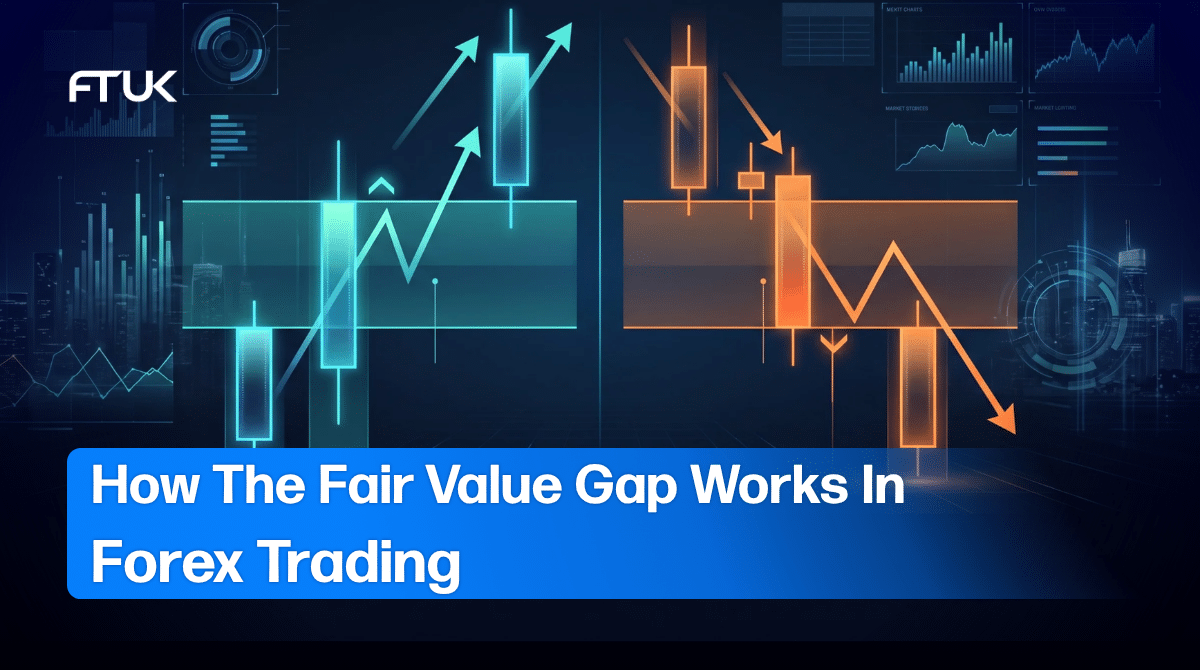
How The Fair Value Gap Works In Forex Trading
The world of forex trading is full of technical concepts, indicators, and strategies that can seem slightly intimidating when you’re starting out.
One concept that has gained significant attention in recent years, particularly among price action traders and Smart Money Concept (SMC) traders, is the fair value gap (FVG).
If you’ve spent any time researching funded trading challenges, instant funding accounts, or one-step prop firm programmes, you’ve probably come across traders discussing FVGs as part of their trading strategy.
But what exactly is a fair value gap, why does it matter, and how can forex traders use it effectively? What is a fair value gap?
A fair value gap (FVG) is a price imbalance that occurs when the market moves aggressively in one direction, leaving behind an area where very little trading activity took place.
In simple terms, the market sometimes moves so quickly that it skips over certain price levels. These skipped levels create a gap between buyers and sellers, resulting in an imbalance that many traders believe the market will eventually revisit.
The idea behind an FVG is that markets naturally seek efficiency. When an imbalance occurs, price often returns to that area before continuing its overall trend.
This creates potential trading opportunities for traders who understand how to identify and use these gaps. Understanding market efficiency
To understand FVGs, it helps to understand how markets generally operate In a balanced market, buyers and sellers interact continuously at various price levels. Price moves smoothly because transactions occur across a wide range of prices.
However, when significant buying or selling pressure enters the market, price can surge rapidly. This rapid movement means some price levels receive very little trading volume compared to surrounding areas. These inefficient areas become FVGs. How to identify a fair value gap
Most traders identify FVGs using a simple three-candle formation Bullish fair value gap
A bullish FVG forms when
The first candle closes
The second candle makes a strong upward move
The third candle continues higher
The key feature is that the low of the third candle remains above the high of the first candle. This leaves an untraded area between those two levels. Bearish fair value gap
A bearish FVG forms when
The first candle closes
The second candle moves strongly downward
The third candle continues lower
The high of the third candle remains below the low of the first candle. Again, this creates an imbalance zone where little trading occurred.
Many charting platforms now offer indicators that automatically highlight FVGs, but understanding how to spot them manually remains an important skill. Why do fair value gaps matter?
FVGs matter because they represent areas where the market may later return. Institutional traders, hedge funds, and large market participants often execute substantial orders that contribute to these rapid price movements.
Some traders believe that when these imbalances occur, the market often revisits them to facilitate additional order flow before continuing its broader direction.
While no trading concept works 100 per cent of the time, FVGs can provide useful areas for
Potential trade entries
Stop-loss placement
Profit targets
Trend continuation analysis
Market structure confirmation
Many traders incorporate FVGs into a wider trading framework rather than using them as standalone signals. Fair value gaps and smart money concepts
FVGs became particularly popular through Smart Money Concepts trading methodologies. SMC traders focus on understanding how larger market participants may influence price movements.
Rather than relying heavily on traditional indicators, they analyse price structure, liquidity, order flow concepts, and market inefficiencies. Within this framework, FVGs are viewed as evidence of institutional activity creating temporary imbalances.
Whether you fully subscribe to Smart Money Concepts or not, FVGs can still serve as useful technical reference points for understanding market behaviour. Using fair value gaps in forex trading
There are several ways traders use FVGs within their strategies. Trading retracements
One common approach involves waiting for price to retrace into an FVG after a strong directional move.
For example
EUR/USD rallies strongly
A bullish FVG forms
Price pulls back into the gap
Traders look for confirmation signals
A long position is considered
The theory is that the gap may act as a support area before the trend resumes. Trend continuation entries
Many traders use FVGs to enter existing trends rather than trying to predict reversals. This can help align trades with market momentum while obtaining a more favourable entry price. Combining with market structure
Some of the highest-quality FVG setups occur when the gap aligns with broader market structure.
For example
Higher highs and higher lows in an uptrend
A bullish FVG forms
Price retraces into the gap
A bullish reaction develops
When multiple factors align, traders often view the setup as having stronger probability. Common mistakes when trading fair value gaps
Like any trading concept, FVGs can be misused. Trading every gap
Not every FVG will produce a profitable setup. Markets create numerous gaps every day, particularly on lower timeframes. Selecting higher-quality gaps within strong trends is often more effective than trading every imbalance that appears. Ignoring market context
An FVG should never be viewed in isolation. Economic news market sentiment, liquidity conditions, and overall trend direction all matter.
A bullish FVG appearing directly before a major interest rate announcement may not behave as expected. Poor risk management
Even the most attractive setup can fail. Successful traders understand that FVGs offer possibilities, not guarantees. Risk management remains essential.
This means
Using stop losses
Managing position sizes
Maintaining favourable risk-to-reward ratios
Avoiding emotional decision-making
Which timeframes work best for fair value gaps?
FVGs can appear on virtually any timeframe. However, many experienced traders prefer higher timeframes because they tend to filter out market noise.
Popular choices include
One hour charts
Four hour charts
Daily charts
Higher-timeframe FVGs often carry greater significance because they reflect larger market movements.
That said, day traders frequently use FVGs on
Five minute charts
15 minute charts
30 minute charts
The best timeframe depends on your trading style and objectives. Fair value gaps and prop firm trading
For traders pursuing funded accounts, FVGs can be particularly useful. Most modern prop firms evaluate traders based on consistency, risk management, and profitability.
Whether you’re participating in a traditional challenge model, a one-step evaluation, or an instant funding programme, maintaining disciplined execution is critical. Many successful funded traders use FVGs because the concept naturally encourages patience.
Instead of chasing price after a strong move, traders wait for the market to return to an area of interest before considering an entry. This can help reduce impulsive trading and improve overall trade selection.
For traders attempting to pass funded challenges, fewer high-quality trades often outperform a large number of lower-quality setups. Fair value gaps versus traditional support and resistance
A common question is whether FVGs are simply another form of support and resistance There is certainly some overlap. Traditional support and resistance focus on historical turning points where price reacted previously.
FVGs focus on market inefficiencies created by aggressive directional movement. In practice, the two concepts often work well together. For example, a bullish FVG that overlaps with a key support level may attract additional attention from traders.
The more reasons traders have to monitor a particular area, the more significant that area may become. Can fair value gaps be automated?
Many trading platforms now offer indicators that automatically identify FVGs. These tools can save time and help traders spot opportunities more efficiently.
However, automation has limitations. Indicators cannot fully understand market context, trend quality, economic events, or trader psychology.
For this reason, many experienced traders use FVG indicators as a visual aid rather than relying on them exclusively for trade decisions. Are fair value gaps reliable?
The honest answer is that FVGs are neither magic nor meaningless. Like any technical analysis tool, they work best when combined with broader market understanding.
FVGs can provide useful insight into areas where price may revisit, but they should form only one component of a complete trading plan.
Successful traders typically combine FVG analysis with
Market structure
Trend analysis
Risk management
Economic awareness
Trade psychology
No strategy wins every trade. The goal is not perfection but developing a repeatable process with a positive long-term expectancy. FVGs: A useful tool for new and experienced traders
FVGs have become one of the most discussed concepts in modern forex trading, particularly among traders using price action and Smart Money Concepts methodologies.
At their core, FVGs represent market inefficiencies created by rapid price movement. Many traders monitor these areas because markets frequently revisit them before continuing their broader direction.
For beginners, FVGs offer a practical way to understand market behaviour beyond traditional indicators. For more experienced traders, they can provide valuable entry, exit, and risk management opportunities.
Whether you’re trading a personal account, working towards a funded account, or looking for a pay after you pass a prop firm challenge, the key remains the same: combine technical tools such as FVGs with disciplined risk management and consistent execution.
The traders who succeed over the long term are rarely those chasing every market move. More often, they are the traders who wait patiently for high-quality opportunities and execute their plans with discipline.