
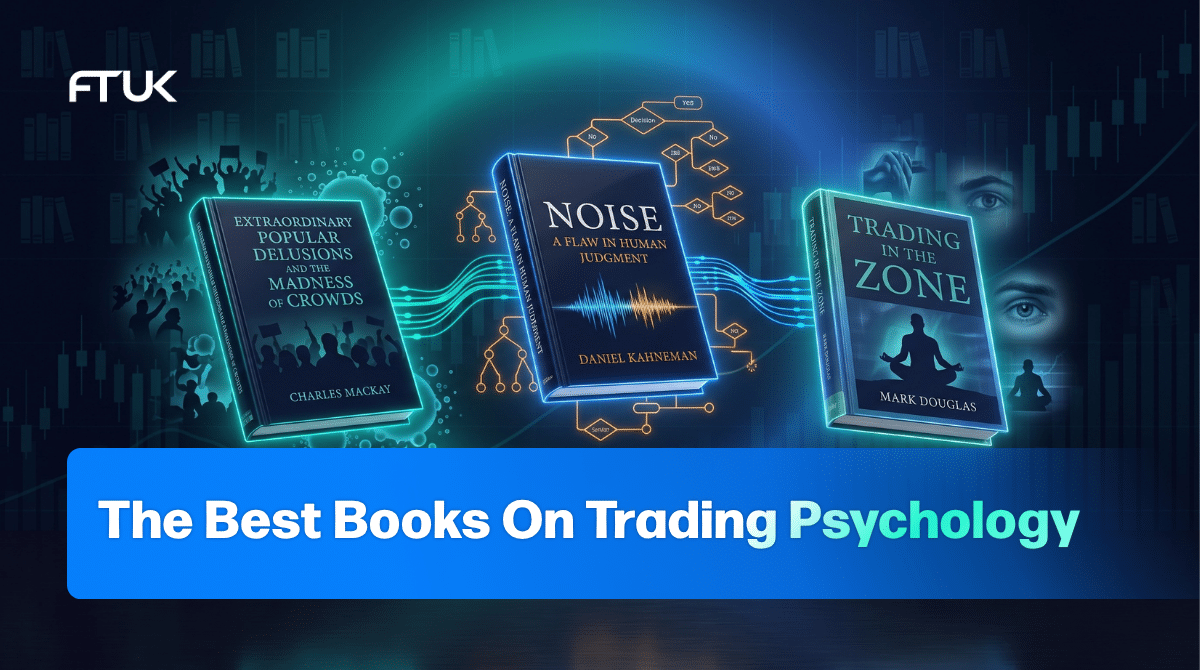
The Best Books On Trading Psychology
In such a highly advanced financial market where technical analysis, focused trading plans and an unfathomable amount of information are used to make trades very quickly, it can be difficult to remember that financial markets are largely made up of humans and thus human error.
Given that a truly efficient market is not only impossible but would cause the entire system to collapse because profit comes from inefficiency, your mindset and the mindset of every other trader are central to making your return.
This is why applicants for the Instant Funding programme at our prop firm come from a diverse range of backgrounds; succeeding in the forex market requires not only a working knowledge of the markets but an understanding of the difference between the markets and how many other investors see them.
This is why trading psychology matters and why it is important to understand not only how the forex market is supposed to work, but also how other people think it is supposed to work, and the types of heuristics, biases and base emotions that drive decision making.
Here are a few of the most interesting books on trading psychology, from a broad spectrum of schools of thought and throughout the history of financial markets. Whilst markets such as the modern forex market are relatively recent, the psychology that underpins them has existed since time immemorial.
The one rule for this list is that they have to be published books, rather than articles or studies published in journals.
Extraordinary Popular Delusions and the Madness of Crowds
One of the very first books on herd mentality, The Madness of Crowds focuses on a wide range of unusual beliefs and historical events, but the first volume is a particularly important early account of economic bubbles and how they catalyse and spread.
Whilst some of the facts surrounding Tulip Mania have been scrutinised in recent decades, and author Charles Mackay was allegedly involved in the Railway Mania bubble of the 1840s, the book is a highly entertaining introduction to the concept and a fun place to start if you are a fan of history.
Bernard Baruch, a major 20th-century financier, cited the book as the reason he sold his stock ahead of the Wall Street Crash.
Key Takeaways
Traders will not always act with rational self-interest.
The driving emotions of fear and greed can cause wild swings in financial markets.
Beware of irrational exuberance and investments where the price is at odds with the value.
Noise: A Flaw In Human Judgment
The late psychologist Daniel Kahneman is a vital figure in the field of trading philosophy; he essentially invented, along with Amos Tversky, tas loss aversion in financial trading.
Many of his books are must-reads if you want to understand why your mind works whilst trading and why you might be prone to making the same mistakes under pressure.
In particular, Thinking Fast And Slow highlights why rushed judgements feel so certain but can be very different to slower deliberations.
However, his final book, Noise: A Flaw In Human Judgement, is even more vital for traders, as it explores the types of factors that affect our judgment and lead the same person to come to very different conclusions whilst armed with the same data.
Whilst its focus is broader than financial markets, and focuses on some Freakonomics-style examples like how the weather can affect which skills will get people into college, it does provide some food for thought on why noise matters and why it should be understood and reduced, even if it cannot be eradicated.
Key Takeaways
Decision hygiene is essential to removing sources of noise that can affect investment results.
Small changes in approach can have huge differences in results.
Noise and bias are interconnected, and reducing the variability of noise can reveal the heuristics that lead to trading mistakes.
Trading In The Zone
One of the ultimate guides to trading psychology, Mark Douglas’ Trading In The Zone has become a borderline-foundational guide for navigating the psychological aspects of trading and building a toolkit of strategies and systems that can help you navigate the emotional aspects of trading.
It is often the first book new traders are recommended to read, and it is difficult to argue with that, given its emphasis on discipline, emotional control, and discovering one’s “edge” in the market.
Key Takeaways
Focus on what you can control, rather than trying to control the market.
Build your confidence throughout your trading strategy and edge, and reward your discipline rather than your results.
Your emotions affect your results, and recognising this power will give you a significant boost.