
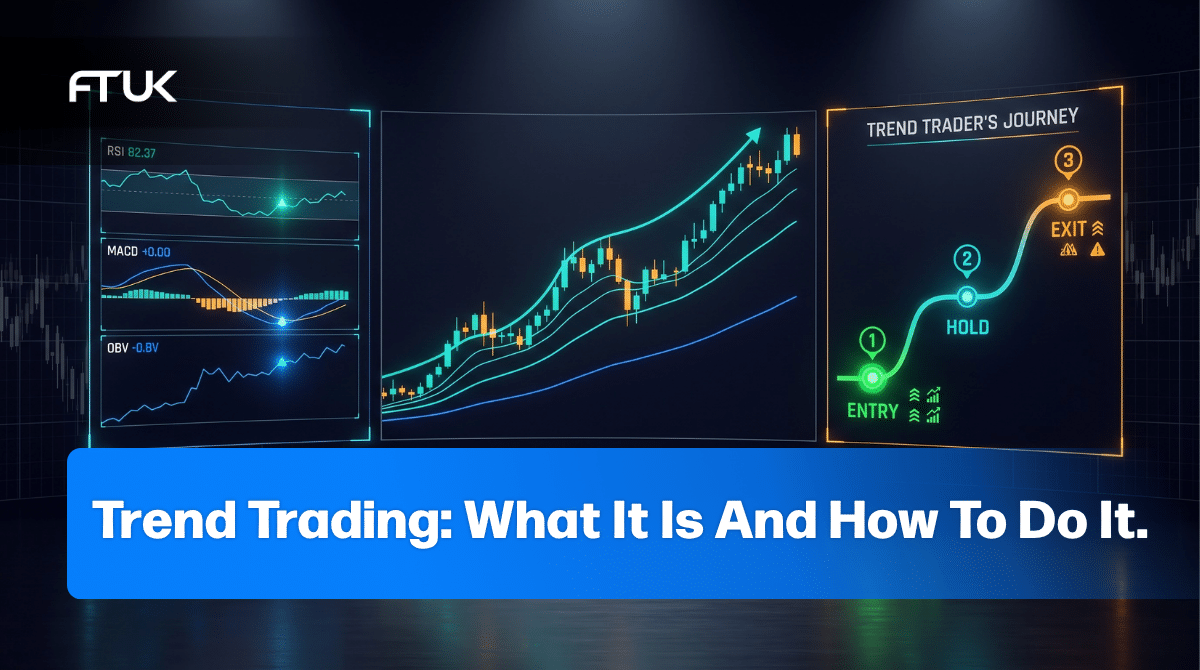
Trend Trading: What It Is And How To Do It
The secret to trading forex is extremely simple in theory and almost impossibly difficult in practice, which has led to the development of a wide range of trading philosophies.
This is part of the reason why the market is so liquid, volatile and fascinating, with countless forex traders taking advantage of prinstant funding programmes in order to challenge themselves against the market and make money doing it.
The ultimate aim is to sell an asset for more money than it cost to buy, but calculating the exact bottom of a valley or top of a peak is nemillions of traders
One of the most popular trading strategies is trend trading, to the point that many traders trust the trend as their greatest ally when dealing with short-term price fluctuations.
Successful trend analysis and trading strategies built on that data can lead to successful returns for years, if not decades, without relying as much on chance.
What is trend trading? How does it work? Should you always trust the trend? And how can you ride trends to long-term returns?
What Is Trend Trading?
It is often said that the best friend of traders is the trend, but what is it, and how does it change your trading strategy?
A market trend is the overall direction a trading market, an asset or a currency is travelling in terms of value.
Whilst the price action constantly changes on a moment-to-moment basis, the trend demonstrates whether the overall value of a particular asset ias the momentum of any change.
Trading a market trend involves identifying the direction of the market, entering the market at a relatively low point and sticking with your investment until a reversal in the trend becomes clearly identifiable.
It is also known as “trend following”, because traders are not necessarily forecasting, market making or blazing a new trail when it comes to their investment strategy, but instead are identifying the prevailing wind and lowering their sails to catch it.
How Does Trend Trading Work?
Trend trading is a relatively intuitive strategy that has historically been very successful. Many traders, particularly individual retail traders, begin by using some variation of trend trading whilst they learn other forms of analysis and how to read their market of choice.
It typically involves finding a breakout following a relative low point, investing at a relatively early stage and then exiting once you identify a downward trend.
This is done by following market indicators rather than the noise of the market itself a level of volatility is natural in any market, but it can provide false positives if you solely follow basic price data as an indication of whether a currency is appreciating or depreciating in value.
Commonly Used Market Indicators For Trend TradingMoving Averages
A moving average averages the closing price of an asset over a set period of time, which eradicates the effect of market noise and focuses on the overall trending direction of an asset. Relative Strength Index
The other type of RSI, this calculates how quickly prices are moving, using a scale from one to 100. Moving Average Convergence Divergence
Also known as MACD, this uses momentum and moving averages to highlight not only the direction of a market trend but also whether the price is moving faster or slower. On-Balance Volume
Known as OBV, this marker focuses on the volume of trades rather than strictly the price, with the idea that the more an asset is traded, the more likely a price movement is and the greater the chance of a trend breakout or confirmation.
Turtle Traders
Whilst trend trading has existed for many years, it became incredibly notable thanks to the Turtle Traders Experiment, where commodity trader Richard Dennis bet his partner William Eckhardt that he could train anyone to trade effectively, rather than it being an inherent special ability of his.
To settle this argument, he gave people who had never traded before his strategy and his money to bet on the financial market by buying a stock when it was trending upwards and selling when it traded downwards.
In just five years, the “turtles” he trained earned over $175m, highlighting that traders who were willing to learn could trade successfully even if they were relative novices.
Should You Always Trust The Trend?
The golden rule of trend trading is “do not fight the ticker tape”. In other words, always trust the trend and invest accordingly.
Should you, though? Whilst trend trading can be successful, it is extremely vulnerable to false positives, which can turn a relatively intuitive and safe trade into an expensive drawdown.
In general, trend trading works best in markets with relatively low volatility, as you are reliant on lagging indicators that are a few steps behind the present market situation.
As well as this, whilst trends are more long-term, a breakout or trend reversal can happen at any time, and as the exit signal needs to be shorter than the entry signal, it can sometimes lead to false moves. This should be factored into your risk management strategy.
Top Tips To Successfully Trade TrendsFocus On Price Indicators
Whilst volume can be a useful indicator, the present price should be the main driver of any trend trading decision. Avoid relying on commentary for your trading advice. Know How Much To Invest
The key strategy for trend following is ensuring that you do not risk too much on single trades. Never invest more than two per cent of your overall account. Plan Your Exit Carefully
As you have less time for your exit than your entry, you should plan the former as much as you would the latter. Know when to hold for profits, when to take your money and when to cut losses. Diversify Your Portfolio
Make sure your larger positions are in less volatile currency pairs, and you have as little exposure to volatility as possible. Big Returns Mean Big Drawdowns
A side effect of trend trading is the risk of false moves, which means deep drawdowns on certain investments. Prepare your risk management strategy accordingly.