
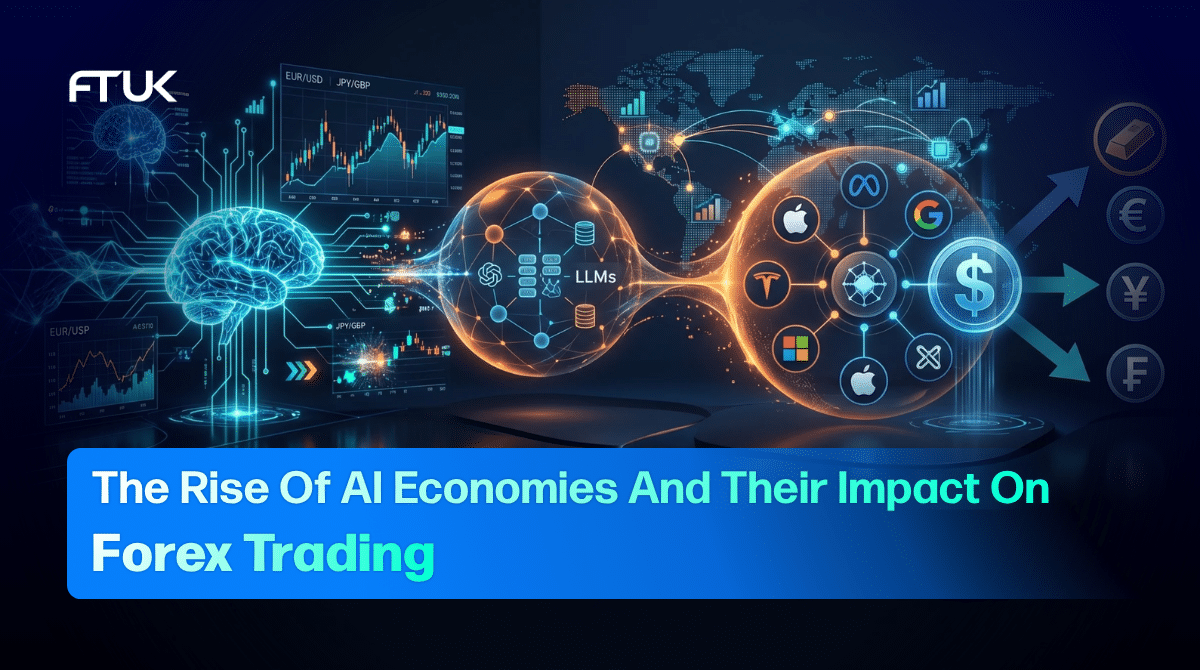
The Rise Of AI Economies And Their Impact On Forex Trading
For better and for worse, AI has had a significant effect on forex trading over the past few years, and every trader, from the smallest ininstant forex funding, has been forced to react to its particularly unusual effects.
Trading has been affected by algorithmic trading practices for decades, using systems that range from exceptionally simple and necessary orders to sophisticated and often opaque strategies that are difficult for the creators to explain, let alone many traders.
However, this is only one way in which AI’s myriad tendrils have affected the market, as the sheer footprint and scale of AI tools and the rather fragile nature of its growth have the ability to affect forex not only within the market itself, but in the same way the dotcom bubble did.
Exactly what its overall effect will be is almost impossible to tell, from a small net boost in GDP to a radical revolution in how we live our lives and interact with the stock market, to a borderline economic apocalypse.
To explain why we need to cover a lot of ground, including explaining what AI is, how it directly and indirectly affects the forex market, and what individual traders can do to prepare for the boom or the bust.
What Is AI In The Context Of Economics?
It is actually a much more difficult question than one might expect to explain AI, as there currently exist two increasingly separate concepts which both happen to be called AI.
At the same time, AI is
A collection of technologies and programming schools of thought which allow for computer programs to simulate aspects of human intelligence and complete tasks that typically require humans to complete.
A technology hype bubble focused on a narrative that AI will integrate into every part of people’s lives and replace a significant number of jobs and lives in ways that sound borderline alchemical.
In the context of how AI will affect forex traders, the focus is much more on the second definition of AI, which consists of large language models which create content, communicate with users and use unfathomably large swathes of training to approximate and produce an answer which looks correct.
This includes tools such as OpenAI’s ChatGPT, Google Gemini, Microsoft Copilot and countless others, often described anthropomorphically as AI ageor agentic AI
They work like highly sophisticated predictive text generators; they use vast swathes of training data and previous interactions to guess the right answer, which to a user would give the impression of conversation, generated content and insight.
Depending on which analysis you choose to follow, AI is a potentially fundamentally transformative series of tools that will forever change the Mechanical Turk, a machine powered by the unpaid or barely-paid work of others.
How Did AI Become So Important For Traders?
Artificial intelligence has existed in theoretical form since Alan Turing, and there have been cycles of development and winter for AI since at least the 1970s when computers became powerful enough and cheap enough for businesses to use.
Algorithmic trading has been used for decades, and AI deep learning tools have been developed to undertake increasingly complex tasks since tsuccess of AlphaGo being a watershed moment.
However, it entered the popular consciousness in late 2022 and early 2023 with the public release of ChatGPT
Whilst far from the first large language model (LLM), ChatGPT was the first to capture the public imagination and led to a swathe of haste integrations of “AI functions” with varying degrees of success, usability and ethics.
However, even if you do not use any AI tools to trade yourself, because others are, it can have a huge effect on trading, and both its irrational exuberance phase and the potential bursting of the AI bubble will affect traders in forex, even if they are not directly trading overvalued AI company stocks.
How Does AI Impact Forex Trading Directly?
The exact impact of AI on forex is difficult to truly quantify, but there are both direct and indirect effects on the market, with the former defined as how AI will affect trading decisions, the development of trading plans and how people and non-human agents engage with the market.
As noted before, the underlying technology behind “AI” has been used a lot since the 1980s in forms such as algorithmic trading and high-frequency trading, as well as in how a trading plan is developed and executed.
As computers can react much faster than people, something that is even more true thanks to the powerful computers and data centres necessary to run AI services.
In particular, there are several potential shifts in trading approach caused by the rise of AI tools
Market analysis has become more sophisticated, with news, market sentiment, price data and interpreting the noise of the market to explore opportunities or avoid potential risks.
The development of short-term predictive analytics strategies that are able to detect patterns in currencies in the short term and develop intra-day strategies.
Even faster automated execution, allowing for better adjusting of positions or initiating trades based on a trading plan, but more quickly executed than a human would be able to.
Enhanced risk management systems, which allow for anomalies in the market to be detected sooner and stop-loss levels to be adjusted.
All of these potential benefits must be tempered with the risks that come with AI integration, both from a technical standpoint and from a philosophical mindset.
AI tools are infamous for making errors, relying heavily on past data, making improper analyses based on opaque interpretations of markeknown as hallucinations
What compounds these issues is that AI tools often cultivate learned helplessness; part of the process of becoming a skilled forex trader is to develop and adjust your trading plan and learn from every trade, both successful and unsuccessful.
AI systems take that away, and if something goes wrong, it can lead to extremely costly mistakes that are difficult to fix because it is difficult to ascertain the logic that led to this.
This is known as the “black box trap” and something that traders who rely on AI in ways that transcend their understanding risk falling into.
This can have a wider effect on how traders will react to market instability and volatility, and create a different type of trading psychology.
How Does AI Impact Forex Trading Indirectly?
However, the biggest effects found with forex trading are less focused on their direct effects on the forex market and more on how AI impacts the variables which affect currency prices and pairs.
The economic effects of AI in the long run are extremely difficult to predict, and this has led to some truly wild predictions for the technology.
Anything from a global increase to the world’s GDP of $7tn to much more conservative gains and even dramatic losses has all been suggested, and it all depends on how widely the tools are used, how efficiently they can be scaled and whether there is a potential return on investment.
The talk of an AI bubble has grown louder in recent months due to the irrational exuberance of the market pushing AI-related tech companies into significantly overblown valuations.
This is particularly the case for the so-called Magnificent Seven, the seven tech companies that were such a big driver of the United States’ economic growth and thus the value of the dollar
These are
Alphabet – The parent company of Google.
Amazon – The world’s biggest ecommerce company, which is a key part of AI infrastructure through Amazon Web Services (AWS).
Apple – Apple’s work with the Siri voice assistant was an early example of AI integration.
Meta – Whilst Meta’s metaverse ambitions have faltered, they have worked to integrate AI into platforms such as Facebook.
Microsoft – The creator of Windows has tried to add Copilot AI functionality into every nook and cranny of the system, as well as invest heavily in OpenAI and other AI companies.
NVIDIA – The world’s biggest producer of computer graphics cards has made a hard pivot towards AI, even describing itself as an AI company.
Tesla – Besides the development of xAI and Grok, Tesla has pivoted towards developing robots instead of cars, as well as attempting to get their self-driving autonomous vehicle technology onto the road.
These companies are either heavily invested in AI or provide the tools and technologies necessary to keep the system working. They have also heavily invested in each other, creating the potential for a massive financial collapse should the AI bubble suddenly burst.
This particularly affects countries which have heavy investments in AI. Whilst the US dollar is the most obvious country affected, with a poflights to security towards the Euro, the yen, the Swiss franc and even to gold, it can affect countries which produce chips and components required to power AI data centres.
Finally, if AI leads to mass layoffs, that can have a huge effect on economic reports, which often causes a downturn in currencies.