
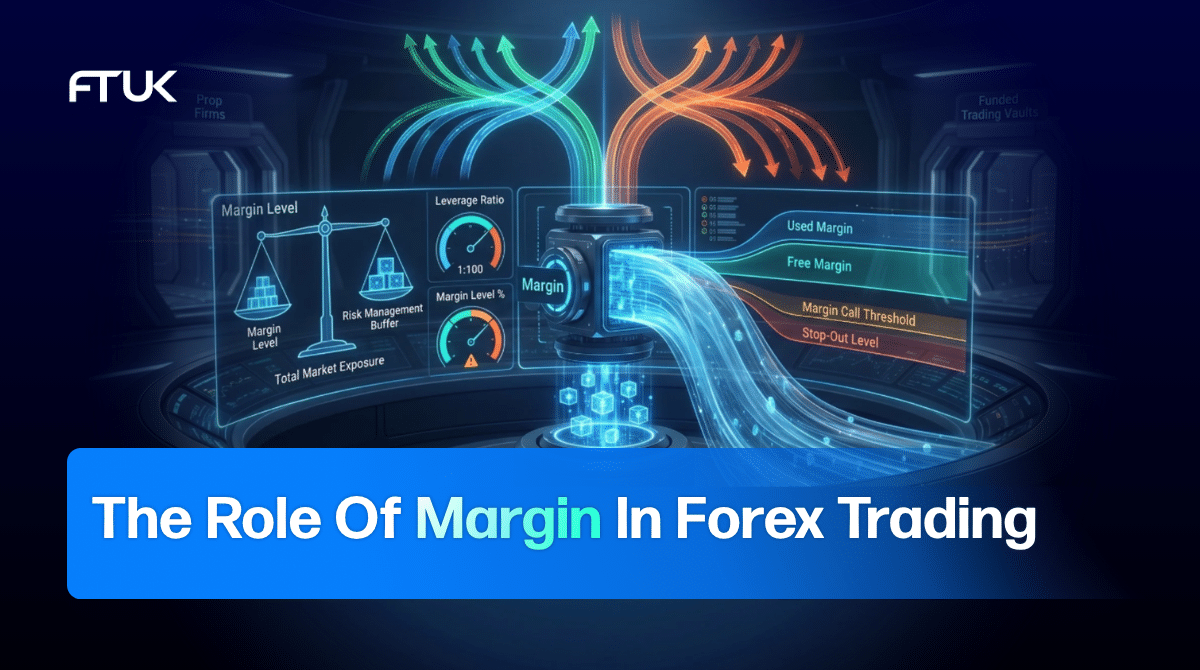
The Role Of Margin In Forex Trading
Forex trading offers opportunities that attract traders from all levels of experience. The market is open nearly 24 hours a day, liquidity is extremely high, and modern platforms make it possible to participate with relatively small amounts of capital.
One of the key features that makes this possible is margin. Margin is fundamental to how the forex market operates, yet it is often misunderstood by beginners. Some traders view it simply as a way to trade larger positions.
In reality, margin is also a risk management mechanism that allows brokers and prop firms to facilitate leveraged trading while maintaining market stability.
Understanding how margin works, and how to manage it properly, is essential for anyone who wants to trade forex responsibly and consistenfunded trading account through a prop trading firm.
This guide explains the role of margin in forex trading, how it interacts with leverage, and why it matters for both beginner and experienced traders. What is margin in forex trading?
Margin is the amount of capital required to open and maintain a leveraged trading position Rather than paying the full value of a trade upfront, a trader deposits a fraction of the total position size.
This deposit acts as collateral that allows the broker or prop firm to extend leverage. For example
A trader opens a $100,000 forex position
The margin requirement is one per cent
The trader must deposit $1,000 as margin
The trader controls a much larger position than the capital committed, which magnifies both potential profits and potential losses.
Margin should not be confused with a trading fee. It is not a cost but rather a portion of funds set aside to support open trades. Margin vs leverage: understanding the relationship
Margin and leverage are closely related concepts Leverage describes how much larger a position is compared to the capital used to open it. If a broker offers 1:100 leverage, the margin requirement is typically one per cent of the trade size.
This means
$100,000 trade requires $1,000 margin
$10,000 trade requires $100 margin
Higher leverage reduces the margin required per trade, allowing traders to control larger positions with less capital. However, this also increases risk, which is why disciplined margin management is crucial. Why margin exists in forex markets
Margin serves several important functions in the forex ecosystem. 1. It enables capital efficiency
Forex is a market where price movements are typically measured in fractions of a per cent. Without leverage and margin, traders would need extremely large capital reserves to generate meaningful returns.
Margin allows traders to participate in the market without needing institutional-scale capital. 2. It protects brokers and prop firms
Margin acts as a risk buffer. If a trade moves against a trader, the broker or prop firm uses the margin deposit to cover potential losses. This ensures that trading accounts cannot accumulate unlimited negative balances under normal circumstances. 3. It supports market liquidity
By allowing participants to trade larger positions, margin contributes to the deep liquidity that makes forex markets so efficient. Types of margin forex traders should understand
To manage risk effectively, traders need to understand several different margin-related terms used on trading platforms.
Used margin
Used margin is the total amount of capital currently locked in open positions.
If you open multiple trades, each position requires margin. The combined total becomes your used margin.
Free margin
Free margin is the capital still available to open new positions.
It is calculated as
Account equity – used margin
Free margin is important because it determines how much additional exposure a trader can take on.
Margin level
Margin level measures the health of a trading account.
It is usually expressed as a percentage
Margin level = (equity / used margin) × 100
A higher margin level indicates more available capital relative to open trades. When margin levels fall too low, brokers may restrict trading activity.
Margin call
A margin call occurs when account equity falls below a specified threshold.
When this happens, the broker or platform may require traders to
Deposit additional funds
Close positions
Reduce exposure
Stop-out level
If losses continue to grow and margin levels fall further, the platform may automatically close trades to prevent the account balance from going negative. This is known as the stop-out level. How margin amplifies profits and losses
Margin is powerful because it allows traders to control larger positions. But that same power cuts both ways.
Consider a simplified example
Scenario without leverage
Trade size: $10,000
Market move: one per cent
Profit/loss: $100
Scenario with 1:100 leverage
Margin required: $100
Trade size: $10,000
Market move: one per cent
Profit/Loss: $100
In this case, a one per cent market move equals a 100 per cent return on the margin used. But if the market moves against the trader by one per cent, the loss is also $100, which could wipe out the margin entirely.
This is why professional traders focus heavily on position sizing and risk management, not just leverage. Margin management: a key skill for forex traders
Many beginners fail not because of poor trade ideas, but because of poor margin management.
Experienced traders typically follow several key principles
Avoid over-leveraging
Just because high leverage is available does not mean it should always be used. Many successful traders use only a small portion of available leverage to maintain flexibility.
Keep margin levels healthy
Maintaining a comfortable margin level reduces the risk of forced liquidation during temporary market volatility. Professional traders often aim for margin levels well above minimum thresholds.
Use stop losses
Stop losses prevent trades from consuming excessive margin if the market moves against the position. Without them, even small market swings can rapidly escalate losses.
Manage total exposure
Opening multiple correlated trades can dramatically increase margin usage.
For example
EUR/USD long
GBP/USD long
AUD/USD long
These positions all depend heavily on US dollar movement, effectively multiplying risk. How do you manage margin in forex prop firm trading?
Margin management becomes even more important when trading through a prop firm.
Many prop firms offer traders access to larger accounts through
Evaluation programs (one-step or two-step challenges)
Instant funding models
Profit-sharing agreements
These models allow traders to scale their capital significantly compared to trading with personal funds.
However, prop firms also enforce strict risk rules, including
Maximum daily drawdown
Maximum overall drawdown
Position size limits
Leverage caps
Because margin determines position size and exposure, poor margin management can lead to rule violations, even if a trade idea itself is sound. Traders who succeed in prop firm environments tend to treat margin as a risk allocation tool, not simply a way to trade bigger. Margin and account growth
Understanding margin properly can help traders scale their accounts more sustainably. When traders increase their account balance, margin requirements become easier to manage.
As capital grows, traders can maintain the same trade sizes while reducing overall risk. This is why many funded traders aim to scale accounts gradually, rather than dramatically increasing leverage after profitable periods. Common margin mistakes beginner forex traders make
Many new traders encounter margin problems early in their trading journey. The most common mistakes include
Trading too many positions
Opening multiple trades simultaneously can quickly consume available margin and reduce flexibility.
Ignoring correlated risk
Traders sometimes believe they are diversified when they are actually taking multiple versions of the same trade.
Using maximum leverage
High leverage may seem attractive but leaves very little room for normal market fluctuations .
Not monitoring margin level
Some traders focus only on profit and loss while ignoring their margin level, until a margin call occurs.
Building awareness of these risks early can prevent unnecessary losses. Why prop firms emphasise risk control
Prop trading firms are not simply looking for traders who can generate profits. They are looking for traders who can manage risk consistently.
From a firm’s perspective, margin discipline demonstrates several important qualities
Strategic thinking
Capital preservation
Professional risk management
Emotional control
Traders who manage margin effectively and develop a good trading mindset are far more likely to succeed when given access to larger funded accounts.
Margin is one of the most important, and most misunderstood, concepts in forex trading. It enables traders to participate in the market with relatively small capital, but it also introduces significant risk when used improperly.
Rather than viewing margin purely as a way to increase trade size, successful traders treat it as part of a broader risk management framework. They carefully monitor margin levels, control leverage, and ensure that no single trade can jeopardise their entire account.
For traders pursuing funded opportunities with prop firms, mastering margin management becomes even more critical. Firms look for disciplined traders who understand how to balance opportunity with risk, protecting capital while steadily building profits.
In the long run, consistent success in forex trading is rarely about taking the biggest positions. It is about managing exposure intelligently, preserving capital during difficult periods, and using tools like margin strategically.
For traders who learn to respect and control margin, it becomes not a danger, but a powerful ally in building a sustainable trading career.